Your carrier owns towers in one country. When you leave it, your phone needs somebody else's towers, and the two companies have an agreement covering that. Data roaming is that arrangement in action, and the bill lands on your account rather than theirs.
The technology is unremarkable and identical everywhere. What varies wildly — by four orders of magnitude — is the price.
When roaming is effectively free
- Inside the EU and EEA, on an EU plan. "Roam like at home" rules have applied since June 2017 and are currently set to run to 2032. A Spanish plan works in Portugal at Spanish prices.
- On a plan that bundles international data. Most premium carrier plans now include a set allowance abroad, often at reduced speed once it runs out. Check the allowance and the country list, not the marketing line.
- Within some regional agreements. Several groups of countries have their own roaming-free zones covering their own residents.
When roaming is expensive
Everywhere else, and it takes two shapes.
Pay-as-you-go roaming is charged per megabyte, and the rates are set for a world where phones sent text. A single megabyte costs roughly what a gigabyte costs on a travel plan. You do not have to do anything unusual to run up hundreds of megabytes in an afternoon — photos syncing to the cloud will manage it while the phone is in your pocket.
Day passes are the modern alternative: a flat fee per day of use, typically in the region of $10 to $15 depending on the carrier and destination. They are far better than per-megabyte rates and far worse than a travel plan, because they bill by the day regardless of whether you used 50MB or 5GB. A two-week trip on a day pass costs more than most people's monthly phone bill.
When to turn data roaming off
- Before you land, if your plan does not include the destination. Switch it off while you are still on the plane. Phones reconnect the moment airplane mode goes off.
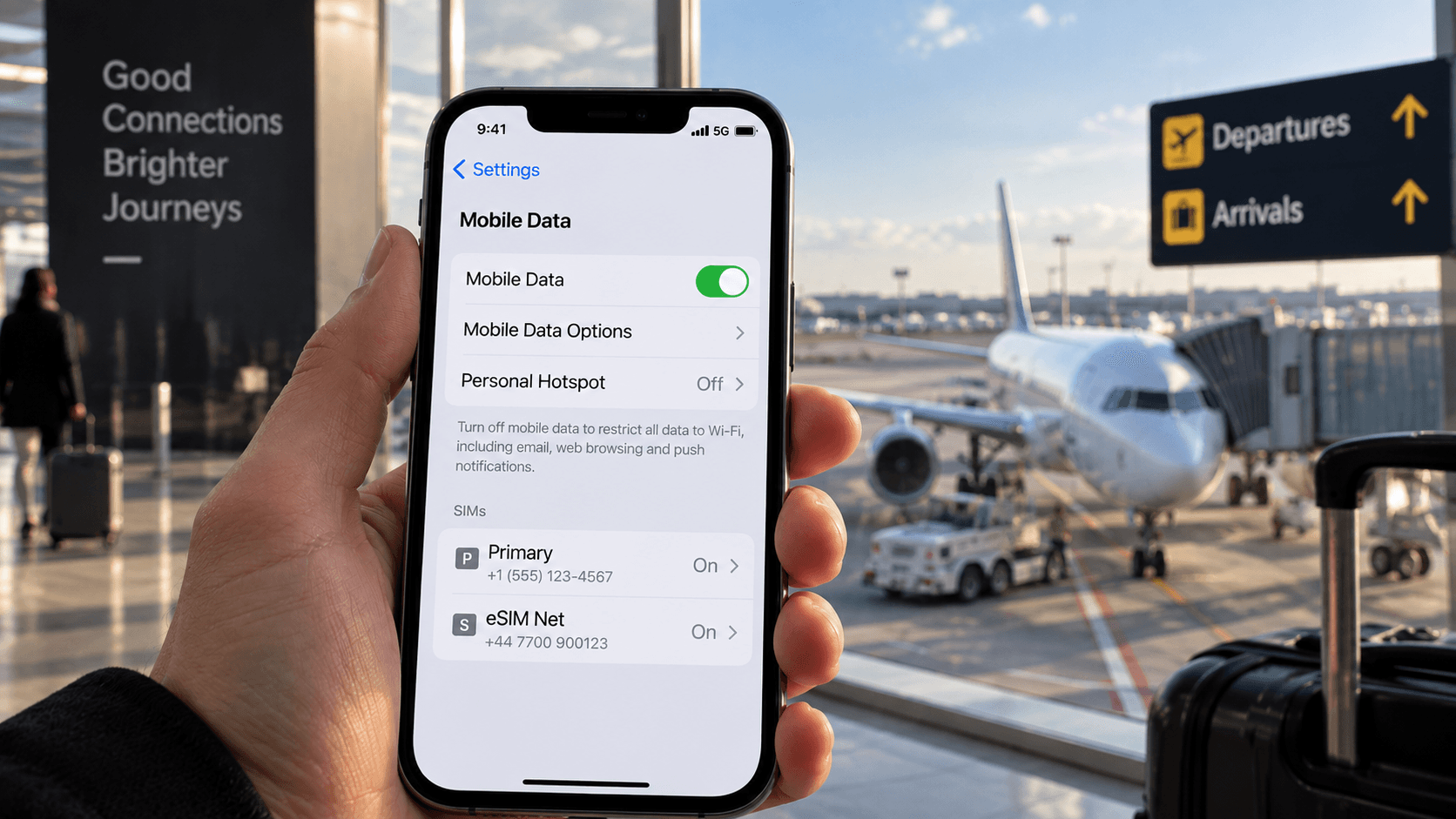
- On your main line, whenever you are using a travel eSIM. This is the single most common way people get a roaming bill they did not expect: the eSIM works perfectly, and the original line quietly roams alongside it.
- Near a land border. Phones connect to the strongest tower, not the nearest one in your country. A hotel three kilometres from a border can put you on a foreign network without you moving.
- On a cruise. Ships run their own satellite-backed networks with their own rates, and they are among the highest anywhere.
Turning it off is under Settings → Cellular (or Mobile) → Cellular Data Options on an iPhone, and under Connections → Mobile networks → SIM manager on most Samsung phones. Do it per line, not globally, if you are running two.
Roaming, mobile data and Wi-Fi are three different things
| What it is | Cost abroad | |
|---|---|---|
| Mobile data | Internet over a cellular network you have a plan with | Whatever your plan says |
| Data roaming | Internet over a cellular network you do not have a plan with | From free to punishing |
| Wi-Fi | Internet over a local wireless network | Usually free, often unencrypted |
Turning roaming off does not turn off mobile data on a plan that covers where you are — which is why a travel eSIM keeps working while your home line sits quietly disabled. And free Wi-Fi is not a substitute for either; see what actually happens on open airport networks.
The cheaper alternatives
A travel eSIM connects to the same local towers roaming would use, at a price set for data rather than for 2007. Compare the two over a real week-long trip, or read how eSIMs work if the idea is new.