International roaming is one of the last places in consumer technology where a price from 2007 is still being charged in 2026. That is not an accident, and understanding why explains most of what is happening in travel connectivity.
The pricing was never about cost
Roaming rates were set when the product being sold abroad was voice and SMS, and when the settlement between two carriers was genuinely complicated. The wholesale cost of carrying a gigabyte has fallen dramatically since. Retail roaming rates, in much of the world, have not moved with it.
That gap is not a mystery — roaming has long been high-margin revenue from customers with no alternative at the moment of use. You discover the price after landing, when switching providers is not an option. Markets with that shape do not correct themselves.
Three things broke it
1. Regulation, in one region
The EU abolished retail roaming surcharges within the bloc in June 2017. Half a billion people learned that using a phone in another country could simply cost nothing extra. That reset expectations well beyond Europe — a traveller who has experienced it does not readily accept $12 a day elsewhere.
2. The eSIM standard
Before eSIM, switching to a local provider meant physically obtaining a SIM in the destination. That friction was the moat. The GSMA's remote SIM provisioning standard removed it: a profile can be delivered over the internet, in seconds, from anywhere.
The moat was never the network. It was the plastic.
3. Phones without SIM trays
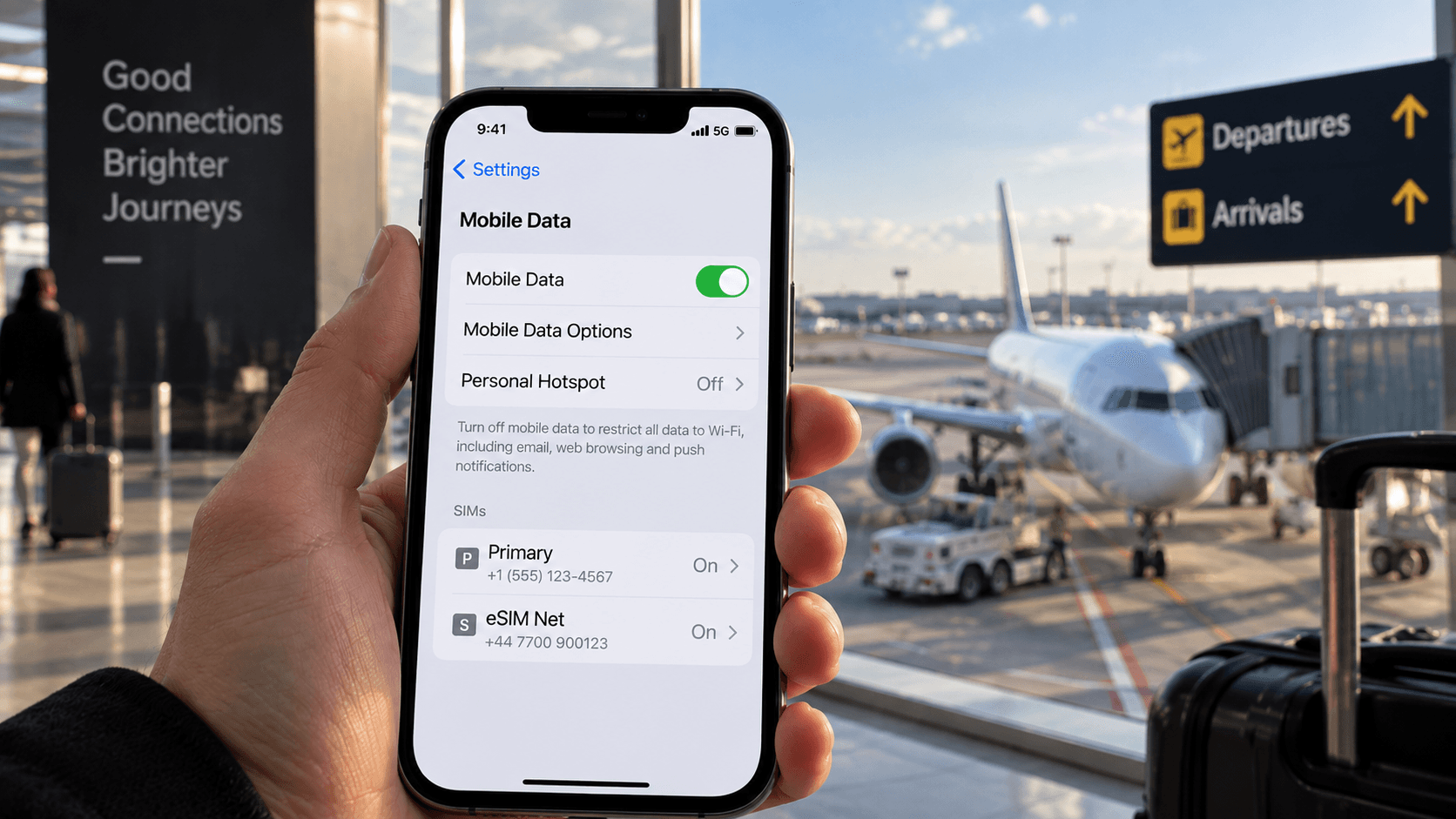
When Apple shipped US iPhones with no SIM slot from the iPhone 14, it made eSIM the default rather than an advanced option. Every one of those users now has a phone that can load a new plan in under a minute, and many discovered it by accident.
What the market looks like now
| Carrier roaming | Travel eSIM | |
|---|---|---|
| Priced by | Day of travel | Gigabyte and validity |
| Discovered | On arrival, often on the bill | Before departure, on a page |
| Switching cost | High, at the moment of use | Near zero |
| Competitive pressure | Historically little | Intense |
The second row is the interesting one. Roaming was a product you bought without seeing a price. Travel eSIMs are bought on a web page, next to alternatives, before the trip — which is a fundamentally different commercial position, and it is why prices in this market keep falling.
How carriers are responding
Correctly, in the main: bundling international allowances into premium plans, extending day-pass coverage, and in a few cases launching their own travel eSIM products. Bundling is the right answer, because it removes the moment of surprise that drove customers away.
It is also slow, and it is mostly happening at the top of the price list. A customer on a budget plan travelling twice a year still faces the old arithmetic.
What we think happens next
- Included international data becomes standard, not premium — the way domestic unlimited calls did.
- The travel eSIM market consolidates. There are far more brands than there are underlying network deals, and that gap closes one way or another.
- Per-megabyte roaming quietly disappears from consumer plans, because it is indefensible and generates complaints.
- eSIM becomes invisible. The winning version of this technology is one nobody has to learn about — you land and it works.
We sell travel eSIMs, so treat the direction of that last list accordingly. But the structural argument holds regardless of who is making it: a product priced per day of travel cannot indefinitely compete with one priced per gigabyte, once customers can see both prices before they fly.