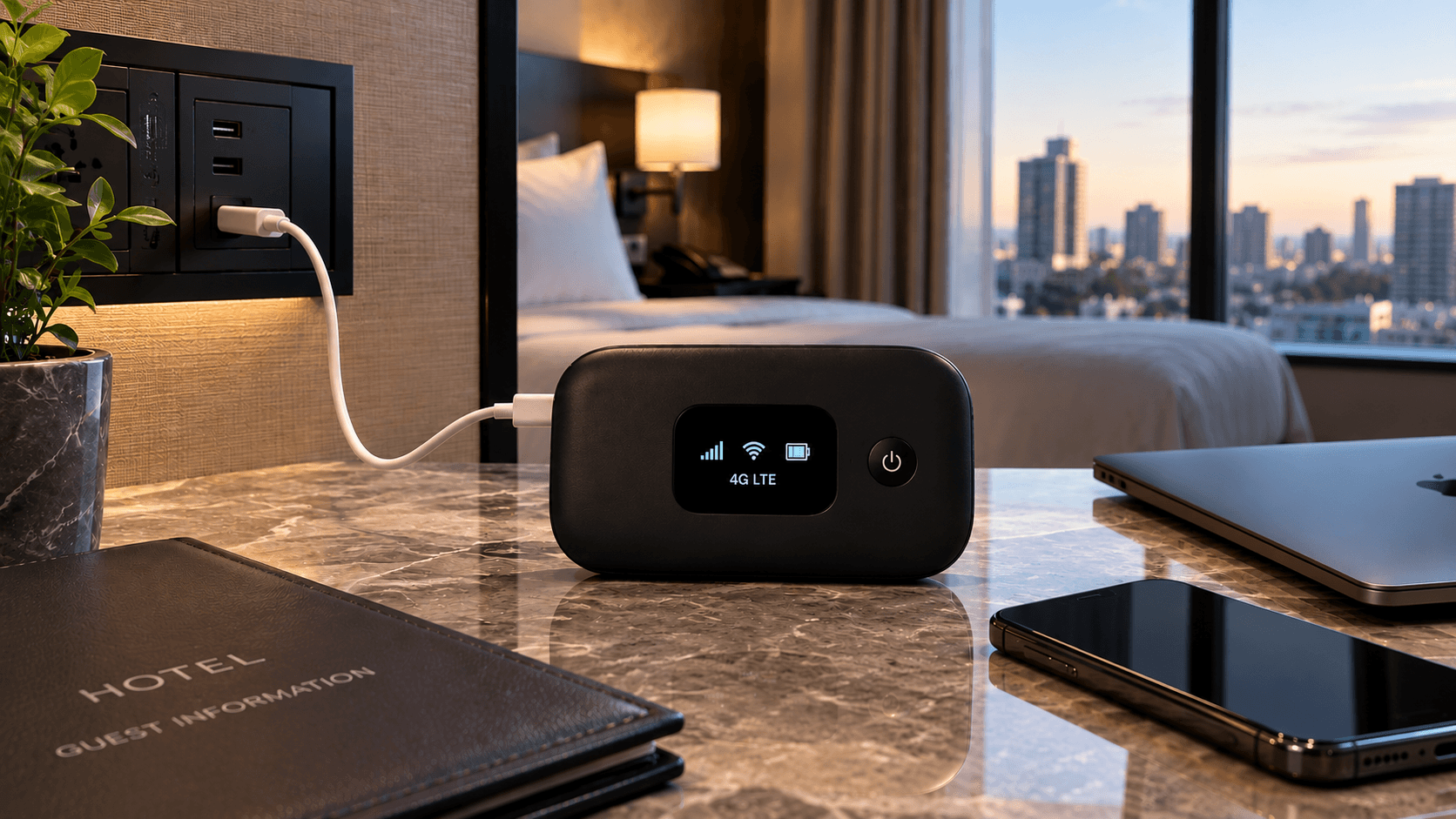
A pocket Wi-Fi — a MiFi, a portable hotspot, a rental router — is a small battery-powered box with a SIM inside that broadcasts a Wi-Fi network for the devices around it. It was genuinely the best option for travellers for about a decade. The case for it is narrower now.
Side by side
| Pocket Wi-Fi | Travel eSIM | |
|---|---|---|
| Extra hardware | Yes — plus its charger | None |
| Battery to manage | Yes, and it dies before your phone | No |
| People it can serve | Usually 5–10 devices | One phone |
| Collection and return | Yes, at a counter or by post | No |
| Deposit | Common | None |
| Works when separated | No — range is a few metres | Yes, it is in your phone |
| Setup | Collect, charge, connect each device | One install at home |
When pocket Wi-Fi wins
One situation, and it is a real one: a group that stays together and shares a connection. A family of four, or three colleagues at a conference, on one rental is usually cheaper than four data plans, and there is one bill instead of four.
It also wins when somebody in the group has a phone that cannot take an eSIM. The hotspot does not care what the connecting device supports.
And for heavy laptop use — a working trip where you will tether all day — a dedicated device with its own battery beats draining your phone.
When it does not
- Travelling alone. All of the overhead, none of the sharing benefit.
- A group that splits up. The moment someone goes to a different museum, they have no internet. This surprises people every single time.
- Short trips. Collection and return can eat a meaningful fraction of a long weekend.
- Late arrivals. Rental counters keep hours. Your flight may not.
The battery problem
A pocket Wi-Fi typically runs six to ten hours, which is less than a day of sightseeing. When it dies, everyone connected to it goes offline at once — usually somewhere with no seats and no sockets. Carrying a power bank for the hotspot, as well as one for the phones, is a normal part of this arrangement and rarely mentioned in the listing.
The middle path
Most groups end up here: one person buys an eSIM and shares it by turning on their phone's personal hotspot when the group is together. Everyone has their own connection when they split up, and there is nothing to return.
Two things to check first. Tethering consumes data quickly, so buy a larger plan or an unlimited one — see how much data you actually need. And confirm the plan permits tethering; most do, some do not.
Deciding
- Four people, one itinerary, one week → pocket Wi-Fi, probably.
- Two people who will split up → an eSIM each.
- One person → an eSIM, without much argument.
- Somebody in the group has an incompatible phone → pocket Wi-Fi, or a local SIM for them.
For the wider picture, every option for getting online abroad is compared here.